
A hyper casual game development company turns one-tap ideas into fast, replayable mobile experiences. From swipe-based challenges and timing mechanics to score-driven gameplay, each hyper casual game development project is shaped around quick decisions and instant feedback. Our hyper casual game development approach considers player behavior, level progression, controls, and performance to create games that feel simple to start but interesting enough to revisit.
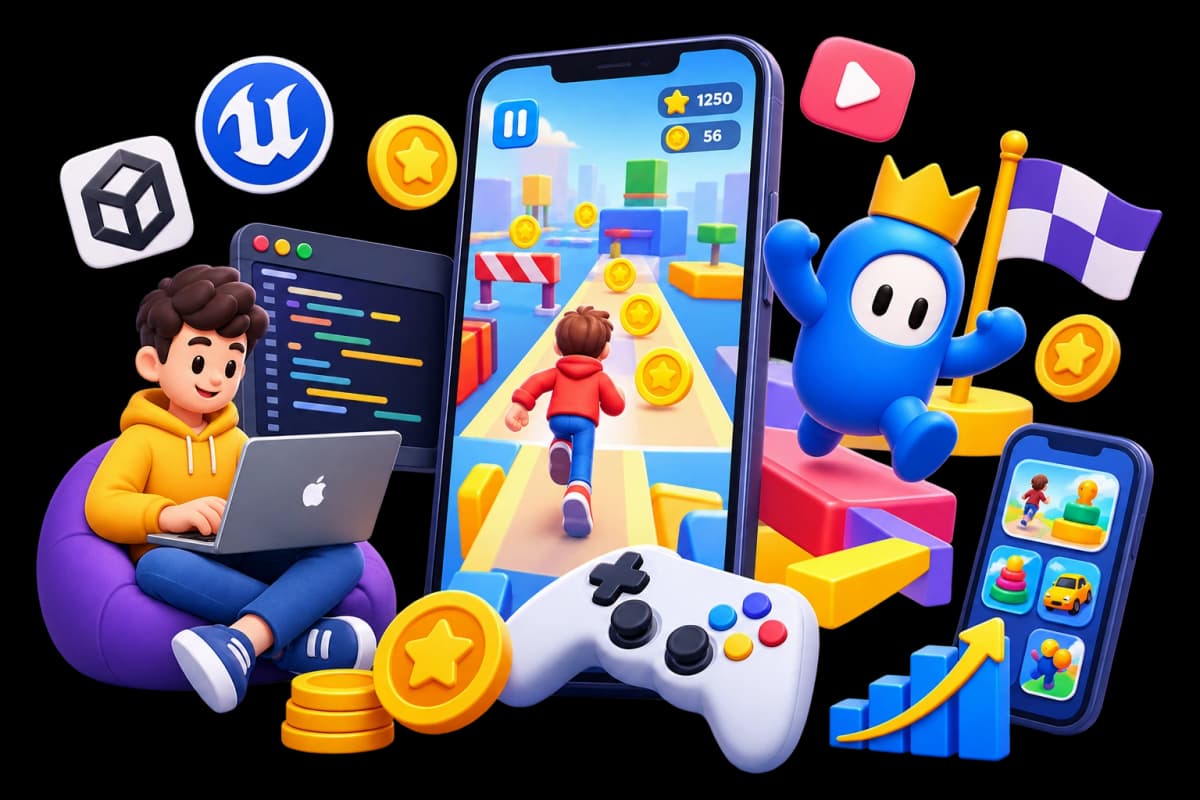
Hyper casual game development focuses on turning a single, easy-to-grasp gameplay idea into a complete mobile experience. Think of mechanics such as dodging obstacles, stacking objects, matching patterns, or timing a tap perfectly. The challenge is to make controls immediately understandable while giving players enough variation, feedback, and progression to keep each short session interesting.
A practical hyper casual game development workflow usually starts with a playable prototype rather than a long feature list. Developers test the core mechanic, refine level difficulty, improve touch responsiveness, and optimize loading and performance for mobile devices. Elements such as game design, user experience, retention, in-app advertising, and player behavior can then shape the final hyper casual game development strategy.

Hyper casual games can reach players with simple mechanics, short sessions, and minimal learning time. Their mobile-first design supports broad audiences, frequent engagement, and flexible monetization through ads and in-app purchases.
Simple controls let players understand the gameplay within seconds.
Minimal learning requirements make hyper casual games accessible to different age groups and gaming skill levels.
Games designed around quick rounds fit naturally into breaks, commutes, and everyday mobile usage.
Score challenges, progressive difficulty, and new obstacles can encourage players to return.
Focused mechanics and lightweight game structures can reduce unnecessary development complexity.
Hyper casual games are naturally suited to touchscreen devices and quick mobile interactions.
Developers can explore puzzles, reflex challenges, arcade mechanics, stacking, racing, and other gameplay formats.
Core mechanics can be prototyped and tested early to understand how players respond.
Advertising, rewarded videos, interstitial ads, and in-app purchases can support different revenue strategies.
Gameplay based on visual interactions can reduce dependence on extensive language-based instructions.
Player behavior, session length, retention, and level completion data can guide ongoing improvements.
A successful gameplay concept can provide a foundation for developing related titles and expanding a mobile gaming portfolio.
Our hyper casual game development services cover concept planning, gameplay mechanics, UI/UX, level design, animation, testing, and optimization, creating lightweight mobile games with responsive controls and engaging play loops.
We create hyper casual games around quick gameplay, intuitive controls, creative challenges, and smooth mobile performance. Each experience is designed for short sessions, easy learning, replayability, and consistent player interaction.
Fast-paced running games with obstacles, rewards, and progressively challenging gameplay.
Simple matching, sorting, stacking, and problem-solving mechanics designed for quick sessions.
Minimal-control games built around tapping, timing, jumping, or directional actions.
Score-focused gameplay with quick rounds, responsive controls, and increasing difficulty.
Timing-based mechanics where players stack, balance, or align objects to achieve higher scores.
Lightweight racing experiences featuring simple controls, obstacles, checkpoints, and competitive scoring.
Casual shooting experiences with straightforward controls, targets, challenges, and progressive levels.
Easy-to-play simulation concepts involving activities such as building, managing, operating, or completing tasks.
Gameplay built around movement, gravity, collision, bouncing, and object interaction.
Reflex-driven games where players navigate barriers, traps, moving objects, and changing environments.
Casual mechanics centered on combining similar objects, completing patterns, or unlocking new items.
Quick competitive experiences featuring real-time challenges, leaderboards, matchmaking, or player-versus-player gameplay.
Successful hyper casual game development combines simple controls, responsive gameplay mechanics, quick challenges, progressive difficulty, and clear feedback. These features create accessible mobile gaming experiences that feel easy to learn and enjoyable to replay.
Easy-to-understand mechanics let players begin playing without lengthy instructions or tutorials.
Tap, swipe, drag, or hold controls create straightforward interactions suited to mobile screens.
Short rounds allow players to complete a meaningful game session within a few minutes.
Visual effects, sounds, animations, and score updates make every player action feel responsive.
Levels gradually introduce faster movement, new obstacles, or tougher challenges to maintain interest.
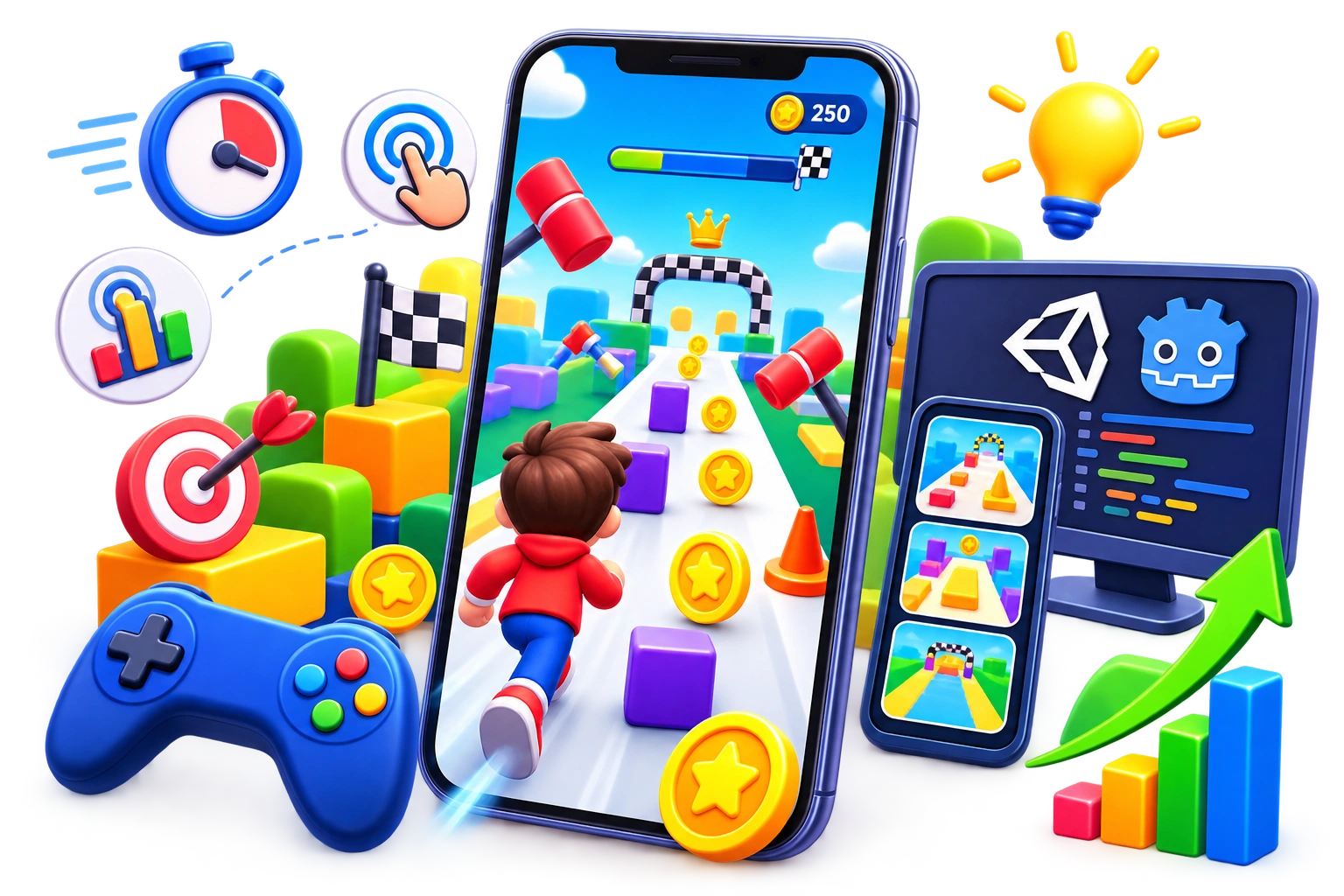
Simple objectives combined with scoring and progression encourage players to try again.
Clean menus and interfaces keep attention focused on the core gameplay experience.
Optimized assets, responsive controls, and efficient loading help maintain consistent gameplay across devices.
Coins, bonuses, unlockable items, achievements, and daily rewards can add meaningful progression.
Competitive elements give players additional goals and opportunities to compare scores.
Rewarded ads, interstitial advertising, and optional in-app purchases can be integrated around the gameplay flow.
Player behavior, session duration, retention, level completion, and engagement data can help guide future game design decisions.
Easy-to-understand mechanics let players begin playing without lengthy instructions or tutorials.
Tap, swipe, drag, or hold controls create straightforward interactions suited to mobile screens.
Short rounds allow players to complete a meaningful game session within a few minutes.
Visual effects, sounds, animations, and score updates make every player action feel responsive.
Levels gradually introduce faster movement, new obstacles, or tougher challenges to maintain interest.
Simple objectives combined with scoring and progression encourage players to try again.
Clean menus and interfaces keep attention focused on the core gameplay experience.
Optimized assets, responsive controls, and efficient loading help maintain consistent gameplay across devices.
Coins, bonuses, unlockable items, achievements, and daily rewards can add meaningful progression.
Competitive elements give players additional goals and opportunities to compare scores.
Rewarded ads, interstitial advertising, and optional in-app purchases can be integrated around the gameplay flow.
Player behavior, session duration, retention, level completion, and engagement data can help guide future game design decisions.

Easy-to-understand mechanics let players begin playing without lengthy instructions or tutorials.
Tap, swipe, drag, or hold controls create straightforward interactions suited to mobile screens.
Short rounds allow players to complete a meaningful game session within a few minutes.
Visual effects, sounds, animations, and score updates make every player action feel responsive.
Levels gradually introduce faster movement, new obstacles, or tougher challenges to maintain interest.
Simple objectives combined with scoring and progression encourage players to try again.
Clean menus and interfaces keep attention focused on the core gameplay experience.
Optimized assets, responsive controls, and efficient loading help maintain consistent gameplay across devices.
Coins, bonuses, unlockable items, achievements, and daily rewards can add meaningful progression.
Competitive elements give players additional goals and opportunities to compare scores.
Rewarded ads, interstitial advertising, and optional in-app purchases can be integrated around the gameplay flow.
Player behavior, session duration, retention, level completion, and engagement data can help guide future game design decisions.
Hyper casual game development combines simple mechanics with broader business value. Faster prototyping, accessible gameplay, mobile performance, replayability, flexible monetization, and player analytics can help shape practical and scalable gaming products.
Hyper casual game monetization works best when revenue features fit naturally into gameplay. Rewarded ads, optional purchases, cosmetic items, and ad-free upgrades can generate income without interrupting player flow.
Players voluntarily watch short videos to receive extra lives, coins, boosts, or other in-game rewards.
Full-screen advertisements can appear naturally between completed levels or gameplay sessions.
Small ad placements can generate recurring revenue without taking over the main gameplay area.
Players can purchase coins, boosters, cosmetic items, extra attempts, or other optional content.
Offer a one-time purchase that removes advertisements for players who prefer uninterrupted gameplay.
A paid version can provide an ad-free experience or additional gameplay features.
Players can complete optional activities or offers in exchange for virtual rewards.
Interactive advertisements can provide an engaging advertising format while creating additional monetization opportunities.
Skins, characters, themes, effects, and visual customization can generate revenue without changing core gameplay.
Limited-time events, themed challenges, and special items can create additional opportunities for in-game purchases.
Related games can be promoted within the existing player base, supporting user acquisition and portfolio growth.
Combining advertising with optional in-app purchases can create multiple revenue streams while allowing players to choose how they engage with monetization.
The hyper casual game development process moves from concept and core mechanics to prototyping, UI/UX design, level creation, testing, optimization, monetization, and deployment, keeping gameplay responsive, lightweight, and replayable.
Define the central idea, gameplay loop, controls, target audience, and overall player experience.
Hyper casual game development can fit gaming studios, startups, publishers, brands, EdTech companies, and entertainment businesses. Gameplay, monetization, features, and distribution can be adapted to each business model.
Develop original hyper casual titles that can be added to an existing gaming portfolio and distributed across mobile platforms.
Build focused games around a single core mechanic to test new concepts and establish an initial player base.
Use rewarded ads, interstitials, and other in-game advertising formats as primary revenue channels.
Offer free gameplay while generating revenue through optional in-app purchases, upgrades, and premium content.
Create paid or ad-free versions for audiences willing to pay upfront for uninterrupted gameplay.
Develop branded mini-games that encourage interaction with products, services, campaigns, or promotional events.
Create games based on existing characters, franchises, shows, or entertainment properties to extend audience engagement.
Use interactive games, rewards, coupons, or branded challenges to encourage customer interaction and repeat visits.
Combine hyper casual mechanics with quizzes, challenges, puzzles, and bite-sized learning activities.
Add lightweight games with leaderboards, challenges, achievements, and sharing features to increase user interaction.
Develop multiple hyper casual concepts using reusable frameworks, assets, and gameplay systems to expand their game portfolio.
Integrate hyper casual games into broader mobile applications or digital ecosystems as an engagement and monetization layer.
Develop original hyper casual titles that can be added to an existing gaming portfolio and distributed across mobile platforms.
Build focused games around a single core mechanic to test new concepts and establish an initial player base.
Use rewarded ads, interstitials, and other in-game advertising formats as primary revenue channels.
Offer free gameplay while generating revenue through optional in-app purchases, upgrades, and premium content.
Create paid or ad-free versions for audiences willing to pay upfront for uninterrupted gameplay.
Develop branded mini-games that encourage interaction with products, services, campaigns, or promotional events.
Create games based on existing characters, franchises, shows, or entertainment properties to extend audience engagement.
Use interactive games, rewards, coupons, or branded challenges to encourage customer interaction and repeat visits.
Combine hyper casual mechanics with quizzes, challenges, puzzles, and bite-sized learning activities.
Add lightweight games with leaderboards, challenges, achievements, and sharing features to increase user interaction.
Develop multiple hyper casual concepts using reusable frameworks, assets, and gameplay systems to expand their game portfolio.
Integrate hyper casual games into broader mobile applications or digital ecosystems as an engagement and monetization layer.

At CryptoApe, we don’t start with a long feature list we start with the moment a player picks up the game. Our hyper casual game development approach focuses on the core mechanic, how quickly it feels natural, and what makes a player want to try one more round. Prototyping and gameplay testing help refine those details before they become part of the final product.
Our work as a hyper casual game development company also extends to the less visible parts of a mobile game. We look at touch response, level pacing, device performance, player behavior, and monetization placement together. This combination of game design, mobile optimization, analytics, and iterative testing helps CryptoApe build experiences that remain simple without feeling repetitive.
At CryptoApe, we use modern, secure, and scalable tech stacks to craft high-performance blockchain & fintech solutions tailored to get Global Reach.













The cost depends on the game concept, gameplay mechanics, 2D or 3D assets, number of levels, platform requirements, multiplayer features, monetization, and testing scope. A clear feature list and prototype can provide a more practical development estimate.
A basic hyper casual game can move relatively quickly from concept to launch because its gameplay is usually focused. The timeline depends on prototyping, art requirements, game mechanics, level complexity, testing, optimization, and Android or iOS deployment.
Yes. An existing concept can be evaluated and converted into a playable prototype. The development process can cover gameplay mechanics, controls, level progression, UI/UX, animations, sound, monetization, analytics, testing, and platform deployment while preserving the original game idea.
Monetization should be placed around the gameplay rather than interrupting important moments. Rewarded video ads, carefully timed interstitials, optional in-app purchases, cosmetic items, and ad-free upgrades can be considered based on player behavior and engagement data.
Yes. An existing game can be reviewed for gameplay friction, level difficulty, controls, loading performance, retention patterns, monetization placement, and user experience. Based on the findings, specific improvements can be prioritized instead of rebuilding the entire game unnecessarily.
Fill a valid information below to get started with our software.
Get Live Demo Today, Instant Launch, and Free consultation.

CryptoApe is an exclusive blockchain and cryptocurrency development company that offers instant and complete crypto solutions to kickstart your business.
Copyrights © 2026 CryptoApe. All Rights Reserved.
