
Custom dApp Development Company
Looking to build a decentralized application around your business requirements? As a custom dApp development company, we build blockchain-powered applications that connect smart contracts, blockchain networks, and user-facing features into a unified solution. Whether you need a DeFi platform, NFT marketplace, Web3 application, or enterprise dApp, we plan the architecture, development approach, and integrations around your product requirements, functionality, and long-term goals.
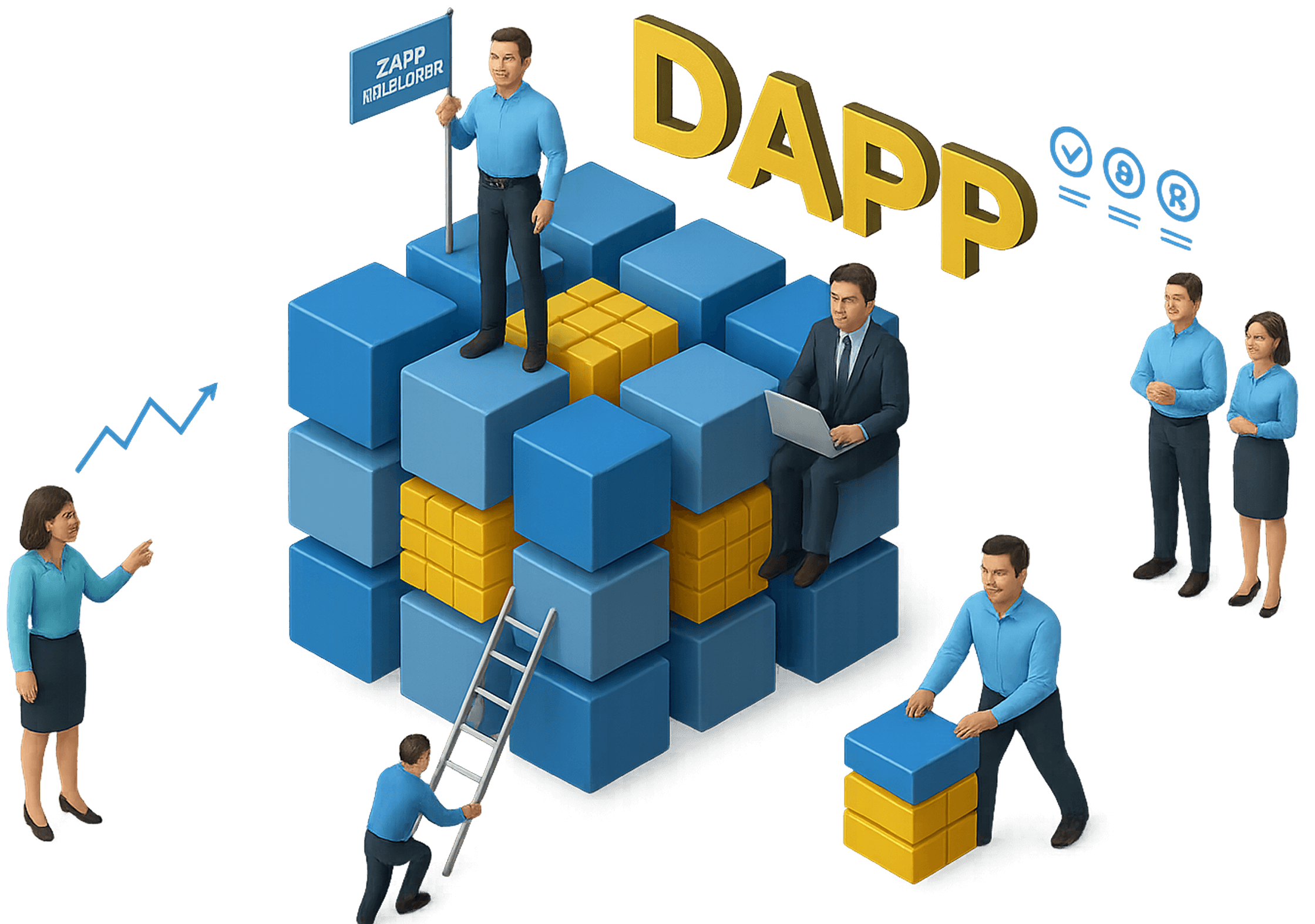
What Is Custom dApp Development?
Custom dApp development is the process of building decentralized applications around specific business requirements rather than adapting a ready-made solution. It involves designing how users interact with the application, how smart contracts execute transactions, and how blockchain networks store and verify data. Depending on the project, development may include custom smart contract logic, Web3 wallet integration, token functionality, user access controls, and on-chain transaction management. Each component is planned around the application's purpose, functionality, and technical requirements.
For businesses developing blockchain-based products, custom dApp development provides flexibility in application features, workflows, and integrations. For example, a fintech company building a lending platform may require automated collateral checks, smart contract-based loan execution, and wallet-based payments. An enterprise developing a supply chain dApp may need product tracking, verifiable transaction records, and role-based access controls. The development process begins by understanding these requirements, evaluating suitable blockchain networks such as Ethereum, Solana, or BNB Chain, and designing an application that supports the intended business operations.

Advanced Blockchain Features for Scalable Custom DApp Development
Build custom dApps with cross-chain connectivity, Layer 2 scaling, smart contract automation, and decentralized storage. These capabilities help manage higher transaction volumes, simplify complex operations, and support future product expansion.

Custom Logic
Smart contract functions are designed around your application's specific business rules and workflows.

Wallet Connectivity
Users can connect crypto wallets to authenticate, sign transactions, and manage digital assets.
Multi-Chain Support
Applications can interact with selected blockchain networks based on transaction needs and ecosystem compatibility.
Contract Automation
Smart contracts execute predefined actions such as payments, token transfers, and lending operations.
Role Management
Access permissions define what users, administrators, and other participants can view or perform.
Token Integration
Supports custom tokens for payments, rewards, governance, staking, and platform utilities.
On-Chain Records
Transaction activities are recorded on the blockchain for independent verification and traceability.
API Connectivity
External APIs connect blockchain functions with payment gateways, analytics tools, and business systems.
Gas Optimization
Contract logic is structured to reduce unnecessary blockchain operations and transaction costs.

Real-Time Tracking
Blockchain event monitoring helps applications display transaction confirmations, token transfers, and contract activity.
Security Testing
Smart contracts undergo testing for access-control flaws, reentrancy risks, and unexpected execution behaviour.
Upgrade Management
Upgrade mechanisms allow supported application components or smart contracts to evolve through controlled processes.
Business Benefits of Custom DApp Development for Scalable Blockchain Applications
Custom dApp development gives businesses control over application workflows, automates transactions through smart contracts, and connects blockchain networks with existing systems, creating room for efficient operations and future growth.

Workflow Control
Design transaction flows, approval rules, and application logic to match how your business actually operates.

Trustless Execution
Allow smart contracts to process agreed conditions without requiring users to trust a central operator for every transaction.

Asset Ownership
Enable users to hold and manage supported digital assets directly through their connected blockchain wallets.

Fewer Manual Tasks
Automate repetitive operations such as token distribution, payment processing, staking rewards, and transaction settlements.

Verifiable Records
Give users and business partners access to blockchain transaction histories that can be independently checked.

Custom Integrations
Connect application functions with existing databases, external APIs, crypto wallets, and third-party platforms.

Flexible Architecture
Choose blockchain networks, smart contract standards, and infrastructure based on your application's technical requirements.

Direct Transactions
Support peer-to-peer payments and digital asset transfers without depending on traditional platform intermediaries for every operation.

Transparent Rules
Make important application conditions, including fees, reward calculations, and transaction requirements, visible through smart contract logic.

Easier Expansion
Introduce additional features such as staking, governance, token swaps, and NFT functionality as the product evolves.

Community Participation
Build governance mechanisms that allow eligible token holders to participate in application decisions.

Product Independence
Maintain greater control over your dApp's features, user experience, business logic, and future development roadmap.
Explore Our Blockchain and DApp Development Services
Explore our blockchain and DApp development services to build secure, scalable Web3 applications with smart contract development, seamless blockchain integration, and user-focused architecture that supports DeFi, NFTs, enterprise platforms, and long-term digital growth.

Custom DApp Development

DeFi DApp Development

NFT Marketplace DApps

DAO Development

DApp Consulting Services

Smart Contract Development

Cross-Chain DApp Development

Gaming DApp Development

Enterprise DApp Solutions

DApp Wallet Development

Tokenization Platforms

Maintenance & Upgrade Services
How Our Custom DApp Development Process Delivers Reliable Web3 Solutions
We turn your dApp requirements into a working Web3 product through structured planning, custom smart contract development, wallet integration, security testing, and deployment, with each stage focused on functionality, reliability, and future growth.

1. Requirement Analysis
Identify your business objectives, target users, application workflows, and the specific problems the dApp needs to address.

4. Architecture Design
Map out smart contract structures, application components, database requirements, APIs, and blockchain communication.

5. UI/UX Design
Design user journeys, wallet connection screens, transaction interfaces, and dashboards around actual application workflows.

8. Backend Integration
Implement APIs, indexing services, databases, and external integrations to support application functions that do not run directly on-chain.

10. Security Testing
Test smart contract logic, access controls, transaction handling, and common vulnerabilities before deploying to production.
2. Use Case Planning
Define on-chain and off-chain operations, user interactions, transaction requirements, and smart contract responsibilities.

11. Mainnet Deployment
Deploy approved smart contracts, configure application infrastructure, and verify contract interactions on the selected blockchain network.

3. Blockchain Selection
Evaluate Ethereum, Solana, BNB Chain, or other networks based on transaction costs, performance, ecosystem, and technical compatibility.

6. Smart Contract Development
Write contract logic for token transfers, payments, access permissions, automated execution, and application-specific operations.

7. Frontend Development
Build the application interface and connect user actions with smart contracts, wallet providers, and blockchain data.

9. Wallet Integration
Connect compatible wallets to support user authentication, transaction signing, asset management, and blockchain interactions.

12. Monitoring & Optimization
Monitor transaction activity, investigate errors, optimize application performance, and implement updates as requirements evolve.
1. Requirement Analysis
Identify your business objectives, target users, application workflows, and the specific problems the dApp needs to address.
2. Use Case Planning
Define on-chain and off-chain operations, user interactions, transaction requirements, and smart contract responsibilities.
3. Blockchain Selection
Evaluate Ethereum, Solana, BNB Chain, or other networks based on transaction costs, performance, ecosystem, and technical compatibility.
4. Architecture Design
Map out smart contract structures, application components, database requirements, APIs, and blockchain communication.
5. UI/UX Design
Design user journeys, wallet connection screens, transaction interfaces, and dashboards around actual application workflows.
6. Smart Contract Development
Write contract logic for token transfers, payments, access permissions, automated execution, and application-specific operations.
7. Frontend Development
Build the application interface and connect user actions with smart contracts, wallet providers, and blockchain data.
8. Backend Integration
Implement APIs, indexing services, databases, and external integrations to support application functions that do not run directly on-chain.
9. Wallet Integration
Connect compatible wallets to support user authentication, transaction signing, asset management, and blockchain interactions.
10. Security Testing
Test smart contract logic, access controls, transaction handling, and common vulnerabilities before deploying to production.
11. Mainnet Deployment
Deploy approved smart contracts, configure application infrastructure, and verify contract interactions on the selected blockchain network.
12. Monitoring & Optimization
Monitor transaction activity, investigate errors, optimize application performance, and implement updates as requirements evolve.
Our End-to-End DApp Development Workflow for Secure Web3 Solutions
We develop custom dApps by connecting smart contract logic, blockchain networks, Web3 wallets, and off-chain APIs. From transaction workflows to testnet validation and mainnet deployment, every stage addresses your application's functional and technical requirements.
1. Business Requirement Mapping
Identify the core problem, user roles, transaction types, and business rules the decentralized application must handle.
2. Feature Prioritization
Separate essential launch features from future enhancements, including token operations, governance, payments, and asset management.
3. Blockchain Assessment
Compare networks such as Ethereum, Solana, and BNB Chain based on transaction fees, throughput, consensus mechanisms, and ecosystem support.
4. System Architecture
Define how smart contracts, frontend interfaces, backend services, APIs, and blockchain data will communicate.
5. Interface Prototyping
Create user flows for wallet connections, transaction approvals, asset transfers, and dashboard interactions before frontend development.
6. Smart Contract Coding
Implement contract functions for business rules, transaction validation, token operations, and automated execution.
7. Frontend Engineering
Develop application screens that connect user actions with wallet providers, blockchain calls, and contract functions.
8. Backend Configuration
Set up APIs, databases, blockchain indexing, event listeners, and off-chain services required for application operations.
9. Wallet & API Integration
Connect wallet providers, blockchain RPC endpoints, external data feeds, and third-party services needed by the dApp.
10. Functional & Security Testing
Validate contract execution, transaction handling, access permissions, edge cases, and vulnerabilities across different user scenarios.
11. Testnet & Mainnet Release
Deploy contracts to a test network, verify application behaviour, and move approved components to the selected production blockchain.
12. Post-Launch Monitoring
Track contract events, failed transactions, network performance, and application errors to identify issues and plan technical improvements.
1. Business Requirement Mapping
Identify the core problem, user roles, transaction types, and business rules the decentralized application must handle.
2. Feature Prioritization
Separate essential launch features from future enhancements, including token operations, governance, payments, and asset management.
3. Blockchain Assessment
Compare networks such as Ethereum, Solana, and BNB Chain based on transaction fees, throughput, consensus mechanisms, and ecosystem support.
4. System Architecture
Define how smart contracts, frontend interfaces, backend services, APIs, and blockchain data will communicate.
5. Interface Prototyping
Create user flows for wallet connections, transaction approvals, asset transfers, and dashboard interactions before frontend development.
6. Smart Contract Coding
Implement contract functions for business rules, transaction validation, token operations, and automated execution.
7. Frontend Engineering
Develop application screens that connect user actions with wallet providers, blockchain calls, and contract functions.
8. Backend Configuration
Set up APIs, databases, blockchain indexing, event listeners, and off-chain services required for application operations.
9. Wallet & API Integration
Connect wallet providers, blockchain RPC endpoints, external data feeds, and third-party services needed by the dApp.
10. Functional & Security Testing
Validate contract execution, transaction handling, access permissions, edge cases, and vulnerabilities across different user scenarios.
11. Testnet & Mainnet Release
Deploy contracts to a test network, verify application behaviour, and move approved components to the selected production blockchain.
12. Post-Launch Monitoring
Track contract events, failed transactions, network performance, and application errors to identify issues and plan technical improvements.
Why do Entrepreneurs Prefer Our DApps Development Service
Launching a Web3 product requires technical decisions that directly affect how users interact with the application and how transactions are processed. We develop custom dApps around your business model, whether you're building a DeFi lending platform, NFT marketplace, tokenization platform, or enterprise blockchain application. From defining smart contract rules and selecting the right blockchain to integrating wallets, APIs, and payment workflows, we focus on the features your product actually needs to operate.
We also consider what happens after the initial launch. Our dApp development approach accounts for contract upgrade requirements, transaction costs, network compatibility, security testing, and future feature additions. You can define how users access your platform, how digital assets move, and how application rules execute on-chain. This gives your business a clear technical foundation to launch, manage, and expand its decentralized application without depending on a one-size-fits-all solution.
Blockchain Networks Supported By Our DApp development Services
We support multiple blockchains ensuring secure DApp solutions.

Ethereum (ETH)
Leading smart contract platform for building secure and scalable dApps.

Binance Smart Chain (BSC)
Cost-effective, fast, and EVM-compatible blockchain for dApp deployment.

Polygon (MATIC)
Layer-2 scaling solution enabling high-speed and low-cost decentralized applications.

Avalanche (AVAX)
Highly scalable network supporting custom dApps with low latency.
Solana (SOL)
High-performance blockchain offering ultra-fast transactions for next-gen dApps.

Polkadot
Interoperable blockchain framework enabling cross-chain dApp development.

Cardano
Research-driven blockchain ensuring security, sustainability, and scalability for dApps.

Tron (TRX)
Efficient blockchain designed for content-sharing dApps and high throughput.
Wallets Our DApp Development Supports
Our DApp solutions supports multi-chain crypto wallets

METAMASK
A popular Ethereum wallet enabling seamless Web3 DApp interactions.

TRUST WALLET
Multi-chain mobile wallet supporting DeFi, NFTs, and DApps.

COINBASE WALLET
User-friendly wallet with built-in DApp browser and security.

WALLET CONNECT
Protocol that connects mobile wallets to DApps securely.

TORUS WALLET
Social login wallet allowing easy onboarding into DApps.

LEDGER WALLET
Hardware wallet providing top-tier security for DApp access.

BINANCE CHAIN WALLET
Browser extension for BNB Chain and Ethereum DApps.

MATH WALLET
Supports 100+ blockchains with cross-chain token management.
Why Choose CryptoApe as Your Custom dApp Development Company?
Turning a blockchain idea into a functional product requires more than smart contract coding. It involves choosing the right blockchain architecture, defining application logic, and connecting the components users need to interact with your platform.At CryptoApe, we develop custom dApps around specific business requirements and application use cases. Our development approach covers application-specific smart contracts, Web3 wallet integration, token functionality, and blockchain connectivity. Whether you're planning a DeFi lending platform, NFT marketplace, tokenization application, or enterprise dApp, we structure the solution around its intended functionality, transaction requirements, and integration needs.From technical planning and development to testing and deployment, each stage focuses on how the application should operate in practice. This helps businesses make informed technical decisions and build decentralized applications that can accommodate future product requirements.